PVC foam board for UV flatbed printing: avoiding head strikes and poor adhesion
Why thickness tolerance, flatness and corona treatment decide whether PVC foam board prints cleanly on a UV flatbed, and what to check before you buy.
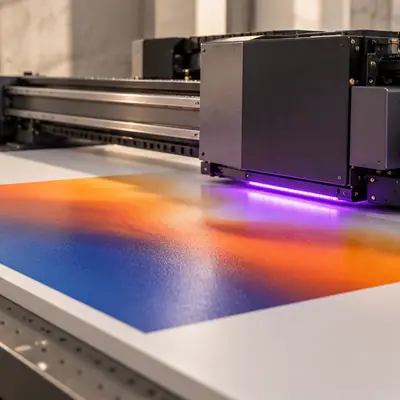
Short answerFor UV flatbed printing, buy PVC foam board with ±0.1 mm thickness tolerance, a corona-treated surface (38 dyn/cm or higher) and anti-static masking, and let boards acclimatise flat for 24 hours before printing.
A UV flatbed printer carries its heads 1–2 mm above the media. That small gap is why PVC foam board quality shows up immediately on a flatbed — and why cheap board can cost far more than it saves.
1. Thickness tolerance
If a nominal 5 mm board varies between 4.6 and 5.5 mm, the printer either sets head height for the thickest point (and blurs the thin areas) or for the average (and risks a head strike). Ask for ±0.1 mm and for how it is measured. We laser-gauge across the full width of every board on the line.
2. Flatness and warping
Warped boards lift at the corners under vacuum and catch the carriage. Warping comes from uneven cooling during extrusion and from poor storage. Boards should be packed flat on rigid pallets with corner protectors and stored flat after delivery.
3. Surface energy and corona treatment
UV ink adheres when the surface energy of the board is higher than the surface tension of the ink. Fresh PVC is borderline; corona treatment raises it to 38 dyn/cm or more. Check with dyne pens if adhesion is critical.
4. Static and dust
Dust attracted by static leaves pinholes and white specks. Anti-static PE masking keeps boards clean until they reach the bed. Peel the film right before printing, not hours in advance.
Pre-print checklist
- Acclimatise boards flat in the print room for 24 hours.
- Measure thickness at four corners and the centre.
- Peel masking immediately before loading.
- Wipe with isopropyl alcohol if the board has been stored unmasked.
- Run a cross-hatch tape test on a corner after curing.
Celuka or free foam for printing?
Both print well when they are flat and treated. Celuka’s hard skin gives a smoother surface for fine detail and resists dents; free foam is lighter and cheaper for short-term indoor graphics.
Frequently asked questions
Why does my UV ink scratch off PVC board?
Low surface energy. Untreated or old PVC board can fall below 36 dyn/cm. Corona-treated board, or a quick wipe with isopropyl alcohol, restores adhesion.
How flat does board need to be for UV printing?
Within about 1 mm across the sheet. Store boards flat on a pallet, never on edge, and keep them in their masking until printing.
Tags: PVC Printing