Cast vs extruded acrylic: which sheet should a sign maker buy?
How cast and extruded PMMA differ in laser cutting, bonding, thermoforming, tolerance and price — and a quick rule for choosing between them.
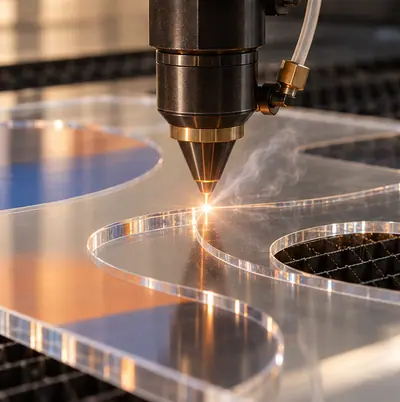
Short answerChoose cast acrylic for laser-cut letters, edge-lit signs, bonding and anything with polished edges or outdoor exposure; choose extruded acrylic when you need tight thickness tolerance and low price for flat, routed or thermoformed parts.
Every acrylic sheet is polymethyl methacrylate (PMMA). The difference between cast and extruded acrylic is how that polymer becomes a sheet — and that changes how it behaves on your laser, your router and your customer’s façade.
How each is made
Cast acrylic is made by pouring liquid MMA monomer between two sheets of glass and letting it polymerise slowly, usually in heated water baths. Long polymer chains form with very little stress locked in.
Extruded acrylic starts as pellets that are melted and pushed through a die, then calendered between polished rollers. It is fast and continuous, which keeps thickness very consistent, but the chains are shorter and aligned in the extrusion direction.
Side-by-side comparison
| Property | Cast acrylic | Extruded acrylic |
|---|---|---|
| Laser-cut edge | Clear, flame-polished look | Frosted, may show melt-back |
| Engraving | Frosted white engraving, high contrast | Clear engraving, low contrast |
| Bonding with solvent cement | Resists crazing | Can craze near stressed edges |
| Thickness tolerance | ±5–10% (we hold ±0.1 mm to 6 mm) | Very tight, typically ±5% |
| Thermoforming | Wide forming window, no shrink | Shrinks in extrusion direction |
| Colour range | Very wide, custom colours easy | Narrower, long runs only |
| Price | Higher | 10–25% lower |
When to buy cast
- Laser-cut channel letters, logos and push-through letters where the edge is visible.
- Edge-lit signs and engraved wayfinding, where clarity and stress-free edges matter.
- Bonded displays, boxes and plinths — cast resists crazing from solvent cement.
- Custom brand colours, which are practical only in cast production.
When extruded is the better buy
- Large, flat glazing and sneeze guards where tolerance and price beat edge quality.
- CNC-routed parts with mechanically polished edges.
- High-volume thermoformed parts designed around its shrinkage.
The question that matters more: virgin or recycled?
Whether cast or extruded, sheet made from recycled or blended MMA looks slightly murky and can yellow within one or two years outdoors. Ask your supplier for the monomer source. Our cast sheet uses 100% virgin MMA from Lucite or Mitsubishi grade feedstock, which is why we can rate it for 10 years without visible yellowing.
A quick rule
If the customer will see the edge, light will pass through it or it will be glued, buy cast. If it is flat, routed and price-sensitive, extruded is fine. When in doubt, ask for A4 samples of both and run them through your own laser.
Frequently asked questions
Can you tell cast and extruded acrylic apart?
Laser-cut a test piece. Cast leaves a clear, polished edge; extruded leaves a frosted edge and smells stronger. Cast sheet also shows little or no shrinkage when heated, while extruded shrinks in the extrusion direction.
Is cast acrylic stronger?
Both have similar tensile strength, but cast sheet has lower internal stress, so it resists crazing around bonded joints and drilled holes better.
Which is cheaper?
Extruded is usually 10–25% cheaper per kilogram because it is produced continuously.
Tags: Acrylic Buying guide